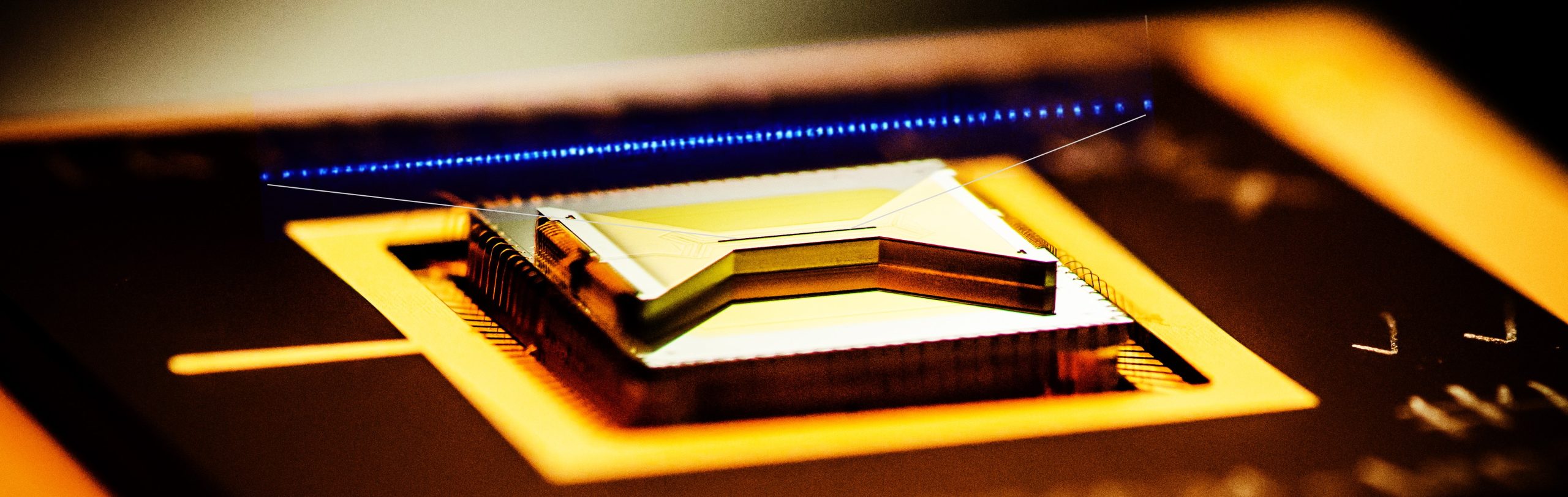
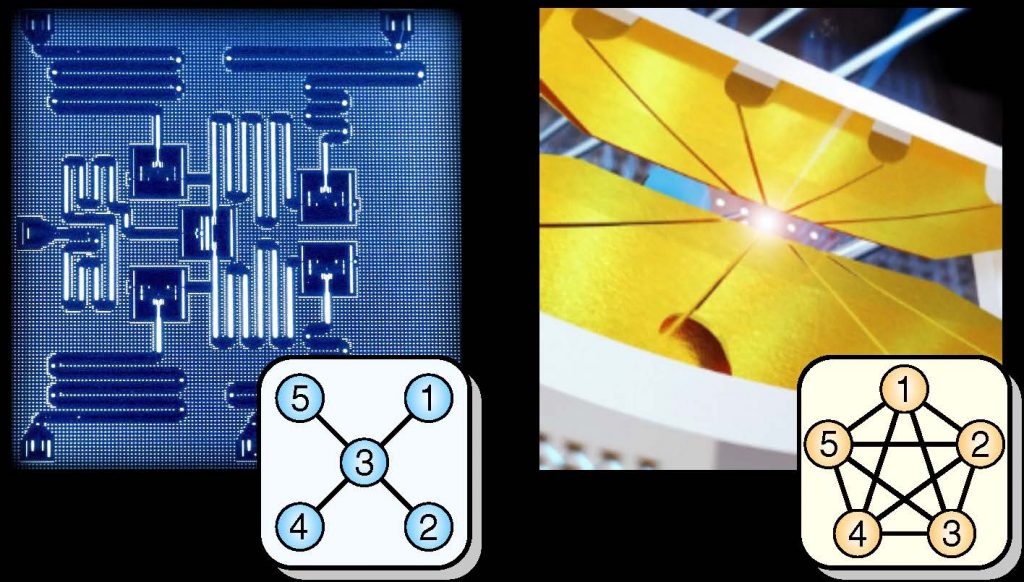
 Connectivity between qubits in a quantum computer may be as important as clock speed and gate fidelity when it comes time to build large-scale quantum computers. We run several quantum algorithms on two 5-qubit programmable quantum computers: our fully-connected ion trap system, and the IBM Quantum Experience superconducting system. The performance is seen to mirror the connectivity of the systems, with the ion trap system out-performing the superconducting system on all results, but particularly when the algorithm demands more connections. This first comparison of algorithms on different platforms shows the power of having a programmable and reconfigurable system, which will be critical to successfully adapt to new quantum algorithms as they are discovered.
- “Experimental Comparison of Two Quantum Computing Architectures,” N. M. Linke, D. Maslov, M. Roetteler, S. Debnath, C. Figgatt, K. A. Landsman, K. Wright, C. Monroe, Proc. Natl. Acad. Sci. 114, 13 (2017). [News Release]
- “Comparison of Cloud-Based Ion Trap and Superconducting Quantum Computer Architectures,” S. Blinov, B. Wu, and C. Monroe, AVS Quantum Sci. 3, 033801 (2021)
 In a delicate balance between strong interactions, weak disorder, and a periodic driving force, a collection of trapped ions qubits has been made to pulsate with a period that is relatively insensitive to the drive. This is a time crystal, where the stable pulses emerge and break time symmetry – just like a freezing liquid breaks spatial symmetry and forms a spatial crystal.
 In a pair of forward-looking articles, Christopher Monroe, Jungsang Kim, and Kenneth Brown layout the only known method for scaling quantum computers based on demonstrated science and technology. The proposed architecture is based on trapped atomic ion qubits, highlighting the need for “co-design” of applications to the machine and modularity.
 It’s just a five-qubit quantum computer, and anything it does is easily simulated on a laptop. However, these trapped ion qubits are fully connected, with entangling gates between all possible pairs. The qubits are dynamically “wired” from the outside with patterns of laser beams, so we can run any algorithm through software without modifying the base hardware. While the individual gate operations are only about 98% pure, it should be possible to exceed the >99.9% purity others have demonstrated with two isolated ions. Most importantly, we have blueprints for scaling this system up to useful dimensions.
 Modularity is everywhere, from social networks and transportation hubs to biological function. Modular systems are always necessary for mitigating complexity, especially in computer systems where the latest processors have up to 256 modular cores.