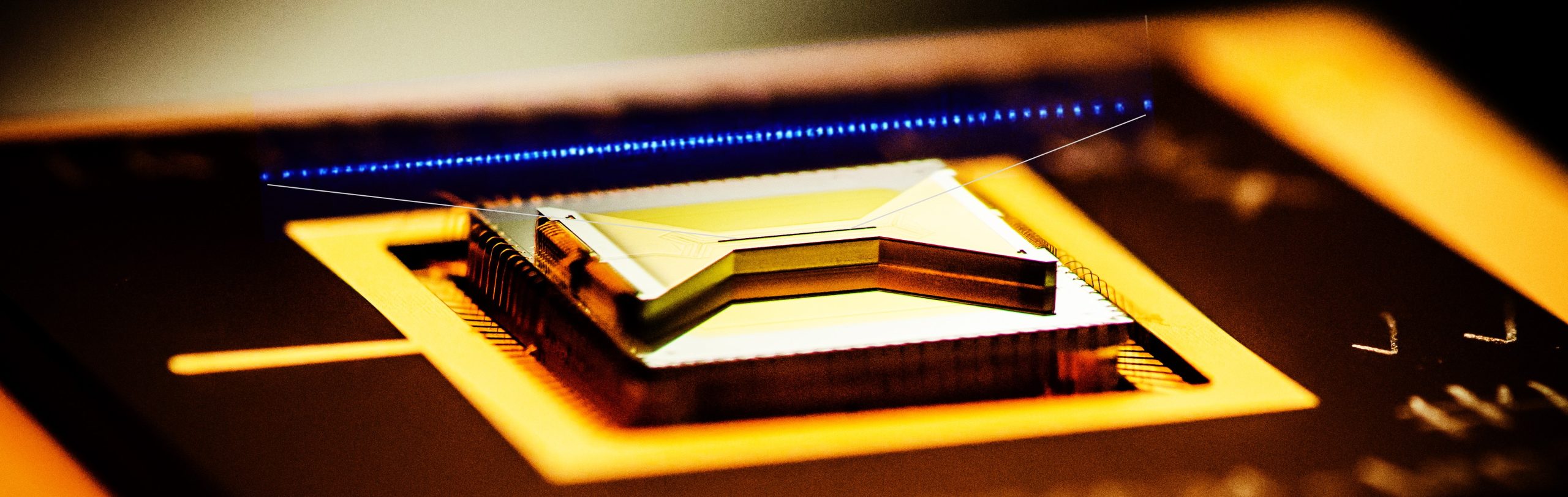
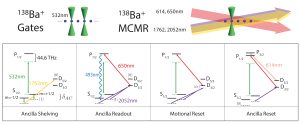
Optical control of atomic qubits looks like the only way to scale quantum computers. However, mid-circuit quantum measurement/reset can be challenging in atomic systems, owing to the use of resonance fluorescence. Even a single resonant photon can destroy quantum coherence in data qubits. Conventional approaches to isolate data qubits from those to be measured involve using multiple species (spectral isolation) or atomic shuttling (spatial isolation). Here we perform mid-circuit quantum measurement/reset with a single species atomic qubit system and without any shuttling — all done in software. Our demonstrations, in two different atomic systems, follow previous OMG* ideas on using auxiliary energy levels in a single atom for different types of qubits that are spectrally resolved. Notably, we demonstrate the components of the schemes by leaving the data qubits alone and performing all shelving and measurement operations on jut the qubits to be measured/reset.
- 171Yb+: “In-situ mid-circuit qubit measurement and reset in a single-species trapped-ion quantum computing system,” Y. Yu, K. Yan, D. Biswas, N. Zhang, B. Harraz, C. Noel, C. Monroe, and A. Kozhanov, arXiv:2504.12544 (2025).
- 138Ba+: “Non-invasive mid-circuit measurement and reset on atomic qubits,” Z.-Y. Chen, I. Goetting, G. Toh, Y. Yu, M. Shalaev, S. Saha, A. Kalakuntla, H. Shi, C. Monroe, A. Kozhanov, and C. Noel, arXiv 2504.12538 (2025).
*OMG is a goofy acronym for “optical/metastable/ground” state qubits [see Appl. Phys. Lett. 119, 214002 (2021)].
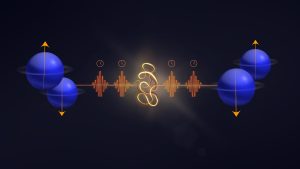
 Typical qubit gate operations are binary, involving operations with up to just two qubits. While this can be universal, it is more efficient for almost all quantum circuits to directly entangle qubits with N-body interactions. With trapped ions, gates are typically realized by applying optical state-dependent displacements to the ions. By instead using state-dependent squeezing forces, the workhorse quantum gate between pairs of trapped ions is extended to an N-qubit gate. This is an important shortcut for most quantum circuits such as quantum error-correction encoding and quantum optimization circuits, while also providing direct N-body interactions for quantum simulations of many-body quantum systems.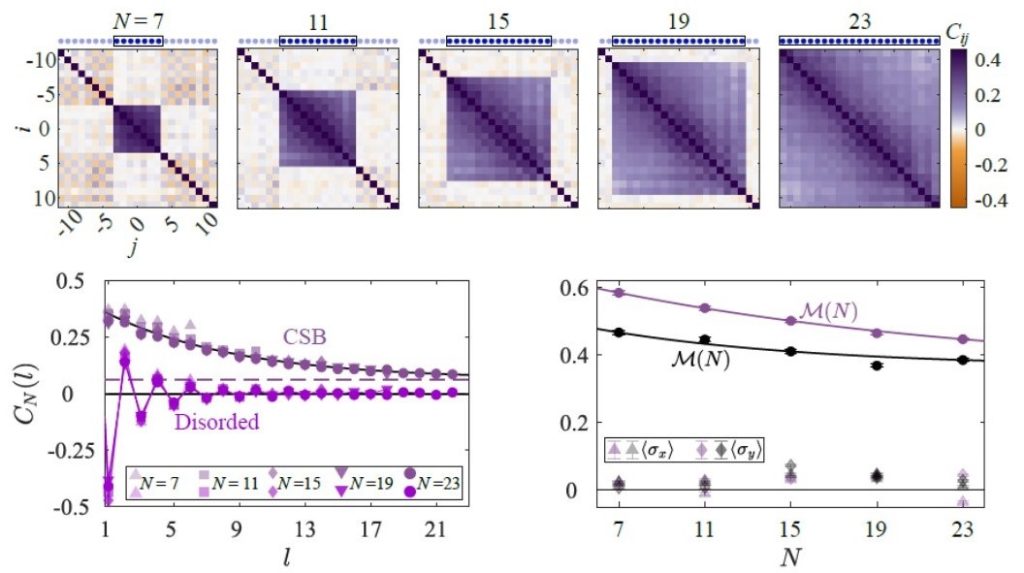

![Encoding and stabilizer readout schematic for the Bacon-Shor [[9,3,1]] error correction process.](https://iontrap.duke.edu/files/2021/10/FTQEC-1024x331.jpg)

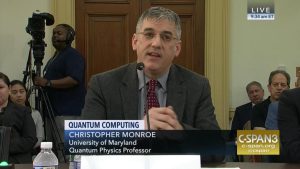 Profs. Christopher Monroe and Michael Raymer spearheaded the U.S. National Quantum Initiative (NQI
 In one of the largest quantum simulations ever performed, up to 53 trapped ion qubits have been used to simulate properties of many body magnetic interactions. The qubits are each prepared with individual control, and measured in a single shot with nearly 100% efficiency. This allows the observation of arbitrary correlation functions that cannot be calculated. This restricted quantum computer becomes fully programmable and reconfigurable with straightforward modifications in the control lasers.